
October · Black History Month
African Dance
Discover African history and culture through authentic dance.
- Key stages
- EYFS to KS2
- Session length
- 45–60 minutes per class
- Group size
- Up to 60 pupils in a hall
- Formats
- Assembly, class sessions or full day with a showcase
How the session runs
Introduction
A continent, not a country
Maps go up first — the countries of Africa, then the geography — and pupils work out for themselves that a continent of 54 countries and 3,000 tribes cannot have one dance. The facilitator introduces the words the session will use, and explains that the dancing ahead draws particularly on West Africa.
Warm-up
Into the music
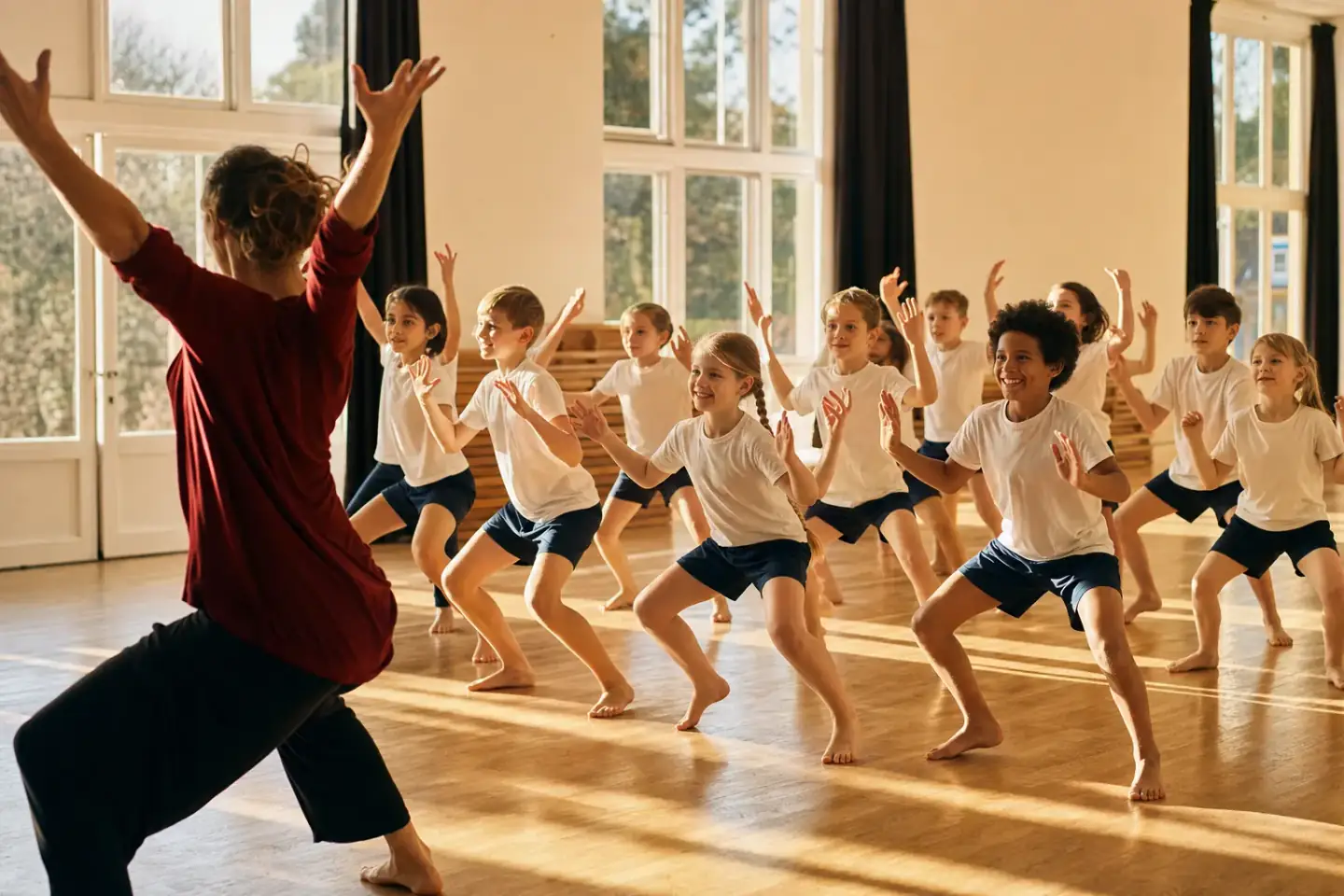
African music goes on and the class warms up to it, starting gently and building: head, shoulder and arm isolations, then stepping, shuffling and stamping. The patterns are repetitive on purpose — they are the movements the session comes back to later.
Explore movement
Stamping, stepping, isolations
Pupils learn African-inspired movements built on the beat: strong rhythmic patterns, stamping and stepping, and polycentric movement — different parts of the body moving independently. Levels and directions change, and pupils get room to improvise, because many traditional African dances are not fixed routines: dancers repeat and respond to the music as it plays.
Create and practise
Their own sequence
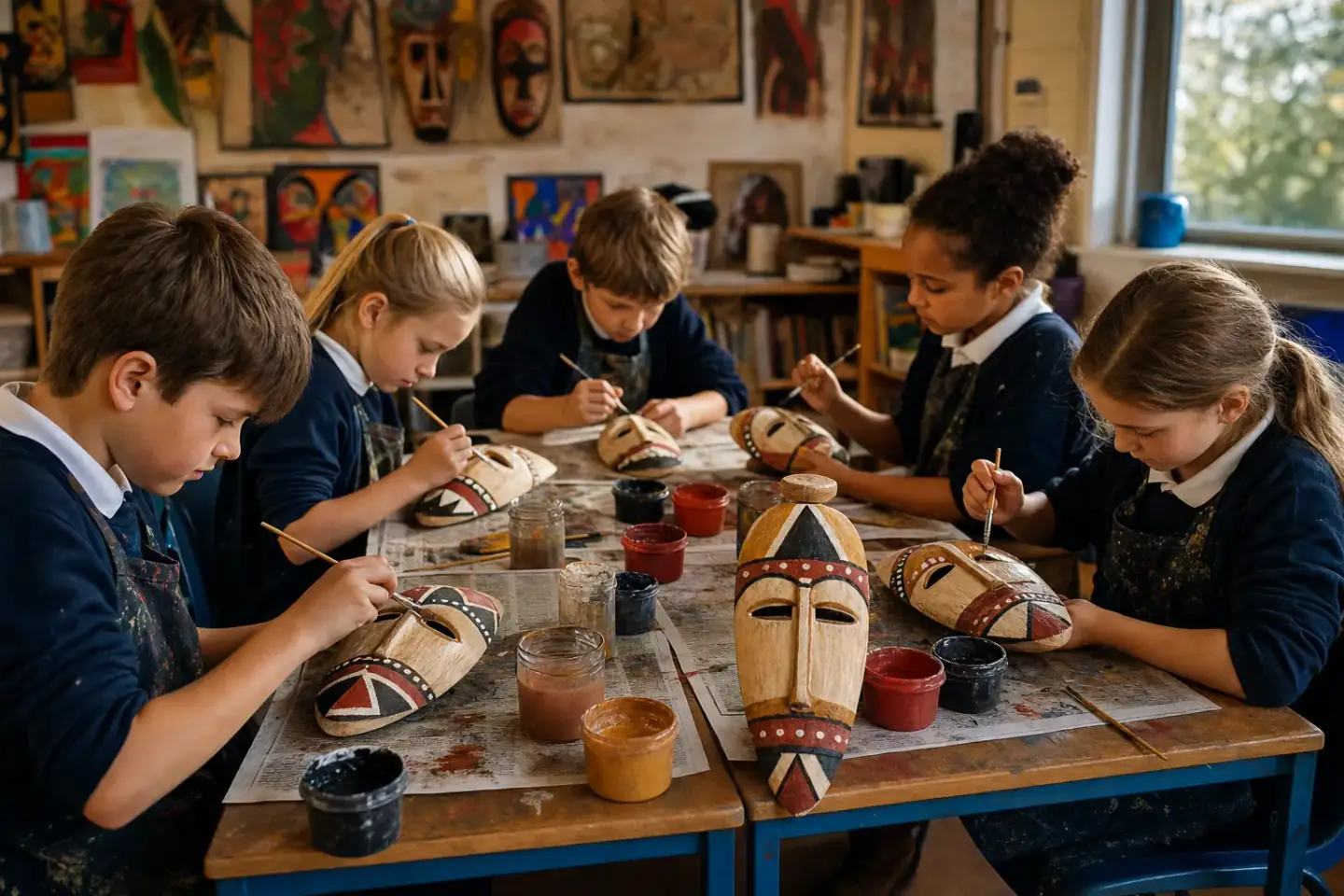
Groups build a short sequence from the movements they have learned, adding their own while holding the rhythm. Speed and complexity are set by the age and ability of the class. Where the day also includes our mask workshop, the masks come into the dance.
Performance
Perform it
Groups perform for one another, or the class dances a final sequence together for the teacher to record if you would like a record of it. Confident performance and respectful watching are both taught.
Cool down
Stretch and reflect
Gentle movement and stretches to finish, then pupils talk in pairs or think on their own: what they learned about Africa, which movement they enjoyed, what polycentric movement and improvisation mean, and what African dance is for.
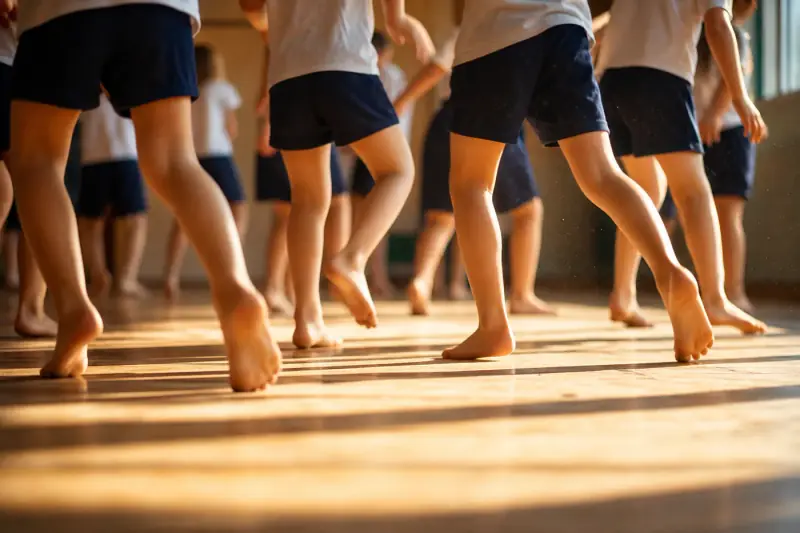
Pupils create the sequence themselves.
What pupils will learn
- The scale and diversity of Africa — 54 countries, over 3,000 tribes and more than 2,000 languages — and why there is no single African dance
- That the term usually refers to traditional dances of Sub-Saharan and West Africa, and that styles differ between countries, regions and tribes
- The three purposes traditional African dance can carry: religious, ceremonial and storytelling
- Polycentric movement, beat, improvisation, ritual and griotic dancing — the vocabulary, used while dancing rather than written down
- Movement built on the beat: stamping, stepping, isolations, repetition and changes of level and direction
- Creating and practising a short group sequence, then performing it with confidence and watching others respectfully
- How African dance has shaped styles pupils already know, including Hip Hop and Street, Samba, Salsa, Jive and the Charleston
Curriculum links
EYFS to KS2
- PE, KS1
- Master basic movements including balance, agility and coordination; perform dances using simple movement patterns.
- PE, KS2
- Perform dances using a range of movement patterns; compare performances to achieve their personal best.
- Music and PSHE
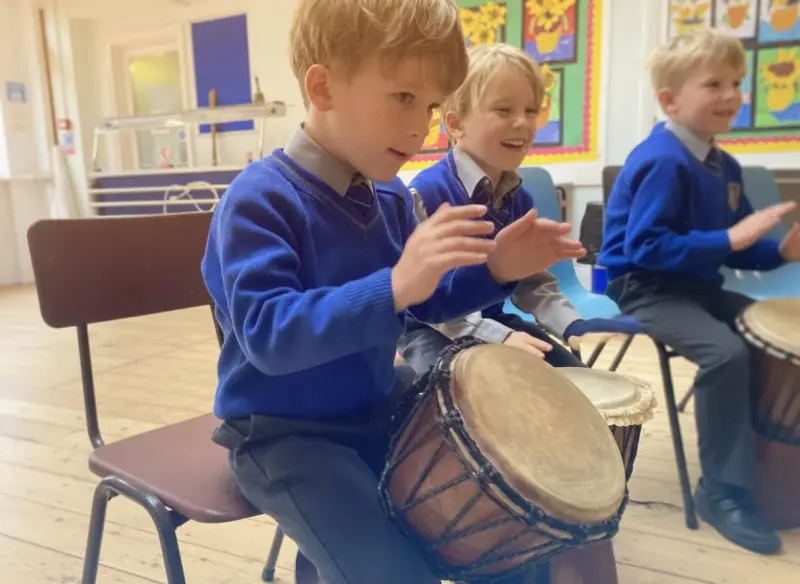
- Beat, rhythm and living cultural tradition — pairs naturally with the African Drumming and Mask Painting sessions on a full day.
- PSHE and citizenship
- Taking part in a shared activity, performing in front of others and watching them respectfully in turn.
- British Values
- Mutual respect: a whole class joining somebody else's tradition on its own terms, starting from what the continent actually contains.
What we bring
- A dance facilitator for every session
- Music for the whole session, from traditional West African to contemporary Ghanaian Highlife and Ivorian Zoblazo
- Maps of Africa and its geography, plus dance photographs and African pattern examples
- A showcase structure and running order for full-day bookings
What we need from you
- A hall or studio with a clear, swept floor and room for a class to travel across it
- Pupils in PE kit, barefoot or in plimsolls — socks alone are a slip risk
- A class teacher present throughout, and ideally one willing to join the final circle
- Fifteen minutes before the first session to set up, and a screen or board if you would like the maps shown large
- A note of any pupil who dances seated or has a mobility need, so the steps are adapted in advance
When to book
October
Black History Month runs throughout October in the UK. We recommend booking several months in advance as October is one of our busiest months.
Reviews for our workshop team
What schools say about our Black History Month workshops
“We have had a number of experiences from the Education Group and are always impressed by the quality of the workshops. We return to them time after time because we know that the planning, content and age-appropriateness of their sessions are absolutely right for the children.”
Kate Baguley “Our infant school aged pupils enjoyed the Maypole experience and were amazed to see the maypole in the middle of their playground. The teacher was fantastic with our young children and we all managed to come away from our sessions feeling we had learnt something rather wonderful!”
St Peter's “Highly recommend the African mask workshop! It's one of the highlights of the Year 5 calendar. Well worth every penny”
Joanne Netto “What a great experience for the children! Ivan was amazing at keeping their interest and making the drumming session as active and exciting as possible.”
Demelza Jones “A great workshop. Fantastic resources and Chris was great with the children. They were engaged throughout and talked about it for ages afterwards. This is the third time we have used them and they never disappoint!”
Julie Gill “Fantastic workshops for primary school children - the facilitators Emma for African drumming and Naomi for dance workshops were friendly, skilled and provided a very enjoyable experience for the children. Thank you!”
Aleksandra Dass
Questions schools ask
What if pupils are self-conscious?
Most are, for about five minutes. Everything is danced as a group — the warm-up moves the whole class at once, sequences are built in groups rather than alone, and nobody performs on their own. Teachers joining in helps more than anything else we could do.
Does it work on a whole-school diversity day on 21 May?
Yes, and the opening is why. Pupils start at a map of 54 countries and learn that African dance is not one thing, which is the point of the day made in the first five minutes. Everybody dances the same session at the same time rather than one group performing their culture at another, and it sits easily alongside sessions from other cultures.
Can we run it for Black History Month in October?
Yes. In October the emphasis falls on the cultural context and on how African dance has shaped styles pupils already know, so it sits alongside the history teaching classes are already doing.
Do we need a dance studio?
No. A hall is what most of these sessions run in. We need a clear, swept floor and enough space for pupils to travel across it.
Can pupils with limited mobility take part?
Yes. The facilitator adapts movements for seated and standing participation, and the upper-body vocabulary and clapping pattern work seated — tell us about the group when you book so it is planned in rather than improvised on the day.
Can we finish with a performance for parents?
Yes. Full-day bookings usually end in a showcase, and parents are welcome — we will help you plan the running order.
Discover African history and culture through authentic dance.
Tell us the date you have in mind and we'll come back within one working day with options for your school.