How to teach Diwali so the story stays with pupils
Tell the story, pass a real diya round, then paint — and pupils leave able to say why the lamps were lit. Here is how to build the afternoon in that order.
Diwali arrives in most primary schools as an afternoon of clay lamps, and it is a good afternoon — paint everywhere, thirty proud lamps drying on the windowsill. Ten minutes of story before the paint comes out is what makes it stay with pupils, so that a week later they can tell you not only that they made a diya but what a diya is for. Same materials, same afternoon, planned the other way round.
Teach the story before the materials
The version most pupils meet is the return of Rama. Rama is sent into exile for fourteen years, his wife Sita is taken by Ravana, the demon king of Lanka, and Rama, his brother Lakshmana and an army of monkeys eventually defeat Ravana and bring her home. Ayodhya lights rows of small oil lamps along walls, thresholds and rooftops so the three of them can find their way in the dark. That last detail is the one to slow down on, because it is the reason the lamps exist at all.
One line — that this is one telling among several — is worth adding, because there is a lot behind it. In much of western India the festival turns on Lakshmi, goddess of wealth and good fortune, and on the start of a new business year: homes are cleaned, accounts are closed, doors and windows are opened so she can come in. In Bengal the same night belongs to Kali. Pupils enjoy knowing that one date carries more than one story.
Light is the anchor, and it is the part that carries
Whichever telling a family follows, the lamps do the same work — light over darkness, knowledge over ignorance, the year turning on the darkest night of the lunar month. Diwali itself falls on that new-moon night, in the middle of a festival that runs across five days. If pupils leave with one idea, it should be that one, because it is the idea every strand shares.
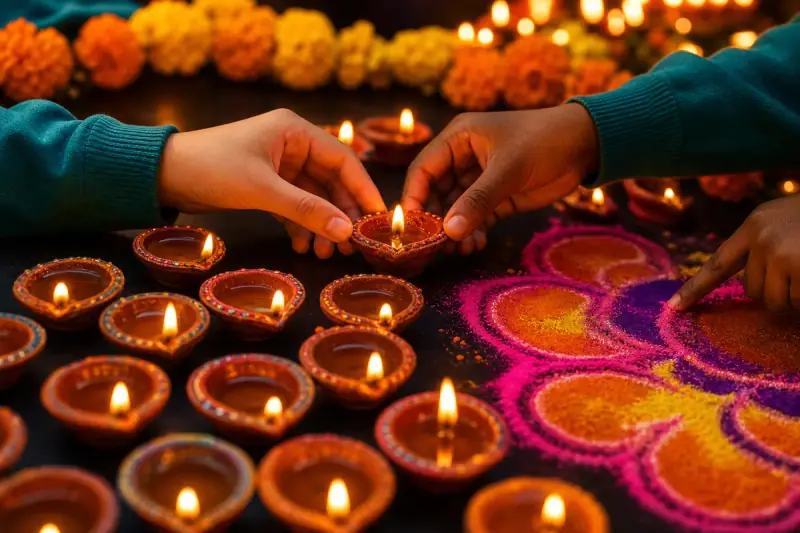
The diya repays a close look before anybody paints anything. It is a shallow unglazed clay dish, cheap enough to be temporary, filled with ghee or oil with a twist of cotton for a wick. Pass a real one round. Pupils notice that it is heavier than they expected, that it is not decorated the way theirs will be, and that hundreds of them in a row are a different object from one on a table. The rangoli patterns drawn at thresholds deserve the same treatment: coloured powder or rice flour, made to welcome a visitor, and deliberately impermanent.
Hindus, Sikhs and Jains are not marking the same thing
The date is shared, the reason is not, and pupils are perfectly able to hold both facts at once.
- Hindus mark the festival of lights, with the story and the emphasis varying by region and by family.
- Sikhs mark Bandi Chhor Divas on the same date — the release of Guru Hargobind from imprisonment at Gwalior Fort, and his refusal to leave without the princes held with him. Lamps were lit across Amritsar for his return, and still are.
- Jains mark the night Mahavira, the last of the twenty-four Tirthankaras, reached liberation. It is reflective — fasting, reading, quiet — rather than a party.
- Many families in British towns and cities mark it with fireworks, new clothes, sweets and relatives, and would describe it as a family occasion before a religious one.
One shortcut is worth stepping around: calling Diwali the Hindu Christmas. It is reached for because it seems helpful, but it tells pupils the festival is a version of something they already know, and it tells the Sikh child in the room that theirs has been filed under somebody else's. Naming each strand takes a sentence and is far more interesting.
What turns the making into a lesson
The making is worth keeping; it is the order that does the work. Hear why the lamps were lit, handle a real one, then paint yours knowing what it stands for and where in a house it would go. Pupils come to the paint already full of the story, and the lamp they take home carries it with them.
A pupil who can tell you why the lamps were lit has learned something they will keep. That is what ten minutes of story buys you.
Three practical points. Check the date each year, because it moves within late October and November, and families that observe it notice when a school gets it right. If you want lamps lit, keep the real flame an adult job and use battery tea lights as the classroom version. And decide before the session where the follow-on lands — narrative writing on the return to Ayodhya, an RE discussion about what light stands for in more than one faith, rangoli as symmetry work in maths. Our Diwali workshops arrive with a facilitator to tell the story, real diyas to pass round and the curriculum links already written, so the afternoon comes with its follow-on attached.